After Midnight: Louis Tomlinson’s Hidden Message in Munich?
It’s a pursuit of uncovering. It positions Louis not as a passive narrator but as an active ‘head of film’ in his own story—a man ready to confront the architecture that was built around him without his input.
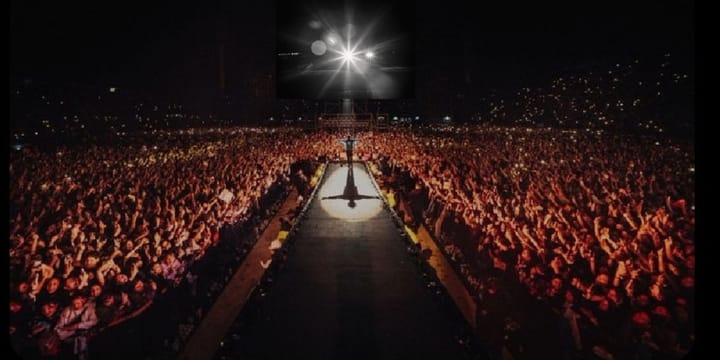
There are moments in an artist’s career that don’t look big at first but to anyone who has followed Louis Tomlinson for years, Munich’s SuperBloom Festival September 8, 2024, felt like a turning point in his solo career. But this was hindsight for me because at the time I didn't notice, only remembering this recently after discovering some other timing, promotional, language, and visual similarities with other artists (maybe I'll post about that another time).
Just before he stepped onto that stage for his final show of 2024, a version of “After Midnight” played—not the original, written and recorded by J.J. Cale, not the standard most remember by Eric Clapton, but the one containing the lyric alteration by Hanna Boel (unknown by most):
- “Going to find out what it is they all lay down.”
rather than - “Going to find out what it is all about.”
Seems at first insignificant - a line most of the audience would not have noticed. Perhaps it was simply John Delf's musical choice, Louis Tomlinson's FOH (Front of House) Engineer and Production Manager. But Louis Tomlinson’s pre-show and post show music never seems random, and certainly not on the cusp of the most dramatic industry/brand repositioning of his solo career (but we didn't know that at the time).
To understand why this may be significant we have to look at everything that changed in the months that followed —the new image, access, press, venues, and the new narrative. Perhaps it was a message.
“Going to find out what it is all about” is a familiar phrasing. Pop-neutral. A simple search for clarity or meaning. But “what it is they all lay down” lives in a different psychological universe entirely.
It suggests something constructed by others, something hidden, buried, or agreed upon, something left unspoken, set in motion behind the scenes, and something he’s consciously prepared to confront.
It’s a pursuit of uncovering. It positions Louis not as a passive narrator but as an active ‘head of film’ in his own story—a man ready to confront the architecture that was built around him without his input.
SuperBloom Munich wasn’t just another festival show. It was the final performance of 2024, the closing of a chapter defined by his DIY grit and grassroots fan momentum. Louis understood the rules of that world. It was a universe built from resilience, not industry privilege.
But 2025 did not follow those rules.
The moment the year began, Louis stepped into a level of promotion, visibility, and institutional support he had never been granted before:
- major press and media placement,
- unprecedented BBC coverage,
- global interviews with real reach,
- high-level industry allies,
- and access to venues he had never been invited to touch—including Madison Square Garden and the Co-Op, facilities tied to the Azoff power orbit and other major-label infrastructure.
Louis has never been handed this level of support. Which means something changed. And the lyric he (or Delf) chose just before the shift suggests he knew it was coming and was preparing to reveal something embedded in the old system.
Why This Version of “After Midnight”? Why That Lyric?
Louis has always communicated through reference—numbers, cars, typography, nostalgia cues, film frames. His choices rarely seem accidental. Choosing the Hanna Boel version matters because that altered line does something the original never could:
It points outward instead of inward. It suggests a system, not an emotion. A collective decision, not a feeling. For over a decade, Louis carried narratives that predated him—roles assigned in boy-band marketing rooms, public assumptions that contradicted the complexity of who he actually is, constraints on his creative identity, and a consistent underestimation that bordered on structural neglect. But now, we are seeing and hearing something very different.
His interviews in 2025 have a tone and message we’ve never heard from him to this degree: direct, confident, unafraid to challenge old narratives, unafraid to talk about loss, pressure, and identity, unafraid to critique the mechanics of fame. It’s the voice of someone finally speaking truth—some revelation yet to come, but also someone smart enough to know how much to speak.
This is where the conversation often turns critical within his fandom. Some people say Louis still isn’t speaking freely. Some accuse him of hiding things—even more harshly, call him a liar. But there is a profound difference between hiding the truth and simply keeping a part of yourself safe.
Louis is still in the music business, a world where image, narrative, and timing are never fully in an artist’s control, and he learned early that anything he said could be twisted, exploited, or weaponized. Some of the stories attached to him were never his to begin with, yet he was expected to confirm or deny them on demand.
Boundaries are a form of power. And sometimes the bravest choice a person can make is to protect the pieces of their life the world believes it’s entitled to. Fans are not entitled to every piece of him.
Louis’s new era is not about broadcasting his entire inner life. It’s about reclaiming authorship of HIS story, his way, and I think also, a bigger story yet to unfold hinted at in his recent videos and interviews.
Louis method is coded transformation. And the lyric choice at SuperBloom seems to fit that pattern. He knows what was laid down about him from all sides (the industry as well as his own fans). He knows what was written without him. He knows the architecture of the myth.
Louis Tomlinson’s career has always been an anomaly. He thrived globally without mega-management, without glossy PR packaging. His fanbase grew out of loyalty, not marketing budgets. That’s precisely why his 2025 support is so telling.
When an artist suddenly receives institutional backing, strategic media coverage, and alignment with major industry power brokers - it means the stories are being rewritten and the system has re-evaluated its investment.
It means the old story no longer serves them—or him—or both. I feel at least two different tracks (paths) being revealed. One to appease the industry (and good for business) and one for himself to finally clarify some old storylines (a personal cleansing, Year of the Snake (remember the 'snake' shirt he wore in Lodz July 26, 2025?)). Read other posts, Is a One Direction Reunion Coming? and The Winner Takes It All
I hope I’m right.
If 2025 was the rise of Louis’s most visible, most empowered, and most strategically supported era, then Munich was the soft fade-to-black on everything that came before:
The underestimation.
The constraints.
The narratives built without him.
The years of fighting for visibility.
The solitude of being the least promoted but the most resilient.
The truth is shifting. The narrative is loosening. And Louis Tomlinson—finally—is stepping into a version of himself that the industry spent years trying to contain. It's not all under his control because that's not the way it works in his business, but I feel his intentionality and agency in this change.
So, I don't think the Hanna Boel lyric was random. It was a quiet signal from the man who never wastes words. I think this time he has a voice in how it gets laid down.