THE 2026 ENDGAME: Narrative Collapse, Data Harvest, and the Final Recalibration of One Direction
This is the end game. And Louis Tomlinson is the chess King (nope, it’s not Harry). Louis walked a perfectly timed, visually appealing (cross-audience), cleverly build promotion that set the stage for 2026.

January 23, 2026. If you read my last article, you know that Harry Styles is on my shit list. He has a voice, but he doesn’t use it. He didn't care enough about Louis Tomlinson to stay out of his way for just a couple of weeks. I might have let that go until he dropped the 'Aperture' video.
However (and this does NOT give Harry a pass), I DO think there is a coordinated effort for a purpose, but it probably isn't what most people think.
“Comin' from outer space, I'm in a better place, oh
Danger's got a sweetness and I've always loved the taste”
That's from his song 'Broken Bones' and I'm giving him a little wink for that one. Louis finally has his feet back on the ground, but the danger isn't over. No time to relax; he has another project that needs to work.
For a decade, five (four, now that Liam is gone) solo careers were orbiting satellites around a crashed mothership—the hiatus. Seriously, it was really a breakup (and some of you have faced that reality). Once Harry signed with the “A” team there would be no going back to boy band status.
The events of January 2026 represent something the fans (of any band or decade I recall) have never witnessed: four surviving members of a legacy act entering overlapping global promotional cycles simultaneously, not to reunite, but to finalize the narrative and harvest the last remaining high-fidelity audience data before the AI-driven catalog economy fully matures.
>> Note: I am NOT happy about AI music, but coming from PR tech and exploring this in the music business, it's happening. Like it or not. I’m going kicking and screaming but I admit I am not the demographic they care about.
This is the end game. And Louis Tomlinson is the chess King (nope, it’s not Harry). Louis walked a perfectly timed, visually appealing (cross-audience), cleverly build promotion that set the stage for 2026.
I. LOUIS: The Mastermind Receives His Well-Deserved Promotion
The most significant data point in the 2026 recalibration is not the music, it is the level of investment in Louis Tomlinson's third album, How Did I Get Here?.
For years, Louis operated as the under-resourced custodian of the band's loyal fanbase, his solo work promoted adequately but never prioritized by Syco or BMG at the level of Harry's Columbia machine. That has changed and there has to be a reason beyond what some want to call “joint promo.” The campaign orchestrated by Untold Studios' Phil Lee represents promotional architecture typically reserved for legacy artists undergoing critical reappraisal—multi-layered Easter egg trails seeded across social media, physical billboards in global cities, a hand-painted sign on a remote Costa Rican beach, and a Tonight Show booking that explicitly framed Louis as a veteran artist emerging from the shadows.
The strategy is precise: Louis is not chasing old conspiracies. He is leaving them behind. He even said that a few times in the last 18 months. Out loud. Yes, I'm saying chickengate. He really did say ‘move on.’ Let it go. New chapter.
His song ‘Sanity’ functions as a quiet declaration of independence. The repetition—"I got my sanity, it's only me and nobody / I know you're mad at me, I don't know what to say"—is not about Harry. It is about the narrative itself. After fifteen years of being interpreted, projected upon, and read through the lens of a relationship put upon him (and Harry), Louis is asserting authorship of his own story. He no longer wishes to feed the story.
BMG's willingness to fund this level of promotion signals something larger: Louis Tomlinson is being positioned as the credible bridge between the band's past and its commercial future as well as his own. He is the only member who has consistently spoken about the legacy with reverence. He is the only one who stayed with Syco until the 2020 restructuring. He is the member the industry trusts not to burn the asset.
II. HARRY: The Aperture Intervention
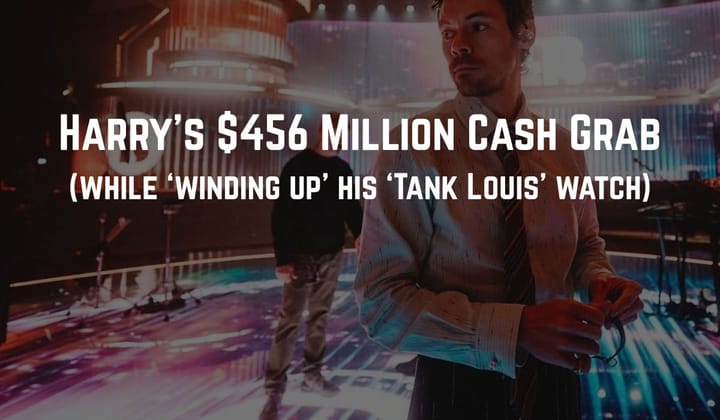
Harry Styles' return from a four-year album silence was scheduled with surgical precision—his single landed on the exact release date of Louis's album. Not a coincidence.
‘Aperture’ is not merely a sonic departure into electronica. Its music video component performs a specific function the mainstream media could never figure out (but that’s true of most of Harry’s videos). It introduces a character—a “creepy stalker man with a lemon bag in pursuit,” a surrealist chase through a hotel, acrobatic lifts, a "circle perfect" structure that ends exactly where it began. The fandom, trained for a decade to decode every visual detail, immediately recognized the echoes. The ‘creepy stalker man with the bag is Louis and his counterpart ‘Larry.’ The purpose of this very specific visual is to collapse it into abstraction.
Harry has never addressed the Larry narrative directly, but in a Rolling Stone article in 2022 he discussed the need to warn romantic partners about the intense scrutiny from a ‘corner of his fandom’. By inserting himself into Louis's promotional window with a video that visually quotes the iconography of their shared history while refusing literal interpretation, he accomplishes something more sophisticated: he turns the narrative into art, then closes the frame. The "aperture" lets light in—but it also defines the boundary of the image. This is Harry drawing the border around his own story and firmly, asking the myth to stay outside it.
The lyrics reinforce the closure in a stark, emotionless, empty hotel: "We belong together / It finally appears it's only love". Not romantic love. Only love—reduced to its elemental form, stripped of names and histories and teen boys on a tour bus. It is a reduction that functions as erasure.
For Harry, the benefit is existential. He is the biggest solo star to emerge from the band; his brand has been perpetually shadowed by a narrative he never endorsed. 2026 is the year he severs that shadow. He does not need to deny. Mainstream media won’t ‘get it’ and his celebrity and Harry-only fans won’t care. He simply floods the zone with his own interpretation.
III. THE ZAYN-LOUIS AXIS: Rewriting the Rupture
If Harry and Louis are collapsing the old narrative, Zayn and Louis are building a new one.
The forthcoming Netflix docuseries, produced by Campfire Studios, has been explicitly positioned by its producers: "It is not a One Direction show. It is a show about Louis and Zayn, formerly of One Direction, who are reconnecting via a road trip". The original fracture of the band is inseparable from Zayn's 2015 departure. This docuseries rewrites that rupture. It replaces "abandonment" with "reconnection." It replaces "estrangement" with "life happens." It replaces the messy, unspoken tension of the hiatus years with a clean, emotionally intelligent narrative of two men who lost touch and found their way back.
The benefit to Zayn is rehabilitation. His solo career has been marked by anxiety-related cancellations and reclusive periods; his public image has oscillated between "mysterious artist" and "unreliable talent." A three-part Netflix documentary about reconnecting with Louis frames his withdrawal not as dysfunction, but as the understandable retreat of an introvert overwhelmed by fame. It positions him as vulnerable, relatable, and—crucially—functional enough to drive across America and film it. His fifth album, KONNAKOL, represents his most culturally rooted work, a return to his Pakistani heritage that anchors him in something deeper than pop stardom. The documentary provides the emotional context; the album provides the artistic substance. Together, they offer Zayn something he has never had: a coherent public narrative that does not require apology.
The benefit to Louis is generational expansion. His core fanbase, forged in the Larry years, is aging and realizing the flaws in the story. The Netflix docuseries introduces him to a new demographic: documentary consumers, Netflix subscribers, viewers who know him as "the witty one from that band" rather than "Harry Styles' alleged toyfriend (not a typo)." This is how legacy is built—not by preaching to the converted, but by appearing in entirely different contexts.
IV. ZAYN'S POTENTIAL AND NIALL'S CONSTANCY
Zayn Malik enters 2026 with a clearer path to industry respect than he has ever possessed.
His Las Vegas residency, launched January 20, signals stability. His forthcoming album, KONNAKOL, is positioned as his most personal and artistically ambitious work. The Netflix docuseries provides the most significant promotional platform of his solo career. If his anxiety remains managed, Zayn is positioned to achieve something Harry has not: a critical reappraisal that separates him entirely from the boy band origin story. Harry is a global superstar, but his critical identity remains tethered to his evolution from One Direction. Zayn, paradoxically, may be freer to transcend it entirely—his departure was so early, his solo sound so distinct, that his 2026 work can be evaluated as the product of a mature artist rather than an escapee.
Niall Horan, characteristically, operates outside this analysis.
This is not a criticism; it is a strategy. Niall has spent a decade as the uncomplicated one—the Irish charm, the golf, the sincere enthusiasm, the absence of controversy. In 2026, while Harry and Louis perform narrative Larry surgery and Zayn undertakes public rehabilitation, Niall quietly announces a collaborative single and prepares his next cycle. His benefit is non-participation in the chaos. He is not collapsing narratives because he was never deeply embedded in them. He is not rehabilitating his image because his image never required repair. In an endgame defined by strategic recalibration, Niall's refusal to recalibrate is itself the strategy. He remains the member you don't have to analyze—and that is, itself, a form of power.
V. THE TRIPLE DIVIDEND: Industry, Members, Asset
What is actually happening in January 2026 is the simultaneous extraction of three distinct forms of value.
For the Industry: The Final Data Capture for the 75% catalog economy
The 75% catalog economy means that established, older music generates the majority of industry revenue, making catalogs highly valuable, stable, and attractive financial investments for investors seeking consistent income.
- Market Share: As of 2021, catalog music claimed roughly 69.8% to 73.1% of total U.S. album consumption, with some trends indicating nearly 75% of streams in 2024 were from older music.
- Stable Investment: Catalogs are viewed as a "hedge" against economic volatility, providing consistent revenue through royalties (streaming, radio, sync) that are not correlated with stock market performance.
- High-Value Acquisitions: Major artists are selling their catalogs for massive sums, such as Queen's $1.2 billion sale in 2024, illustrating the high value placed on these assets.
- Industry Impact: This shift means that while streaming has grown, a huge portion of that revenue goes to older, established music rather than new releases.
The 75% catalog economy means legacy acts are now infrastructure. But the One Direction catalog, unlike Queen or Fleetwood Mac, lacks a generational bridge—the band never recorded with AI, never released archival material, never authorized a definitive documentary. The labels face a problem: they own the original masters, but they do not own a high-resolution map of how the audience relates to them.
The 2026 coordinated activity solves this. By releasing music simultaneously across four labels, the industry creates a controlled environment for behavioral tracking. How does a fan move between Harry's Spotify page and Louis's Discord server? Do they stream "Aperture" before "Palaces," or after? Which emotional clips from the Netflix docuseries generate the longest view times? When Sony eventually deploys AI tools to extend the catalog—synthetic vocals, personalized listening experiences, dynamic archival content—they will do so with a dataset of unprecedented specificity, gathered during the window when all four members were actively feeding the machine. This is also why we're seeing so many leaks. Because the industry wants it all, all the data. All the voice prints. I posted about this data collection last August. Read: Louis Tomlinson: Anomaly
For the Members: Narrative Sovereignty
Each participant in the 2026 endgame receives something they individually require:
- Louis receives promotional investment commensurate with his role as custodian, and a clean break from the narrative that has defined him externally for fifteen years.
- Harry receives the closure of ambiguity—not denial, but aesthetic transcendence. He turns the story into art, then closes the book.
- Zayn receives rehabilitation and reintroduction, framed not as a comeback but as a homecoming.
- Niall receives continued relevance without the psychic cost of narrative entanglement.
For the Asset: Finalization
The One Direction catalog enters 2027 with something it has never possessed: a complete, authorized emotional context. The 2026 albums and docuseries provide a compelling story with the deep emotional texture One Direction fans have always loved. When the AI-driven exploitation begins—when Sony deploys the tools they have spent years developing, they will do so against a backdrop of resolved narrative tension. The story is no longer unfinished.
The members have spoken, not as a band, but as individuals who share a history and are now, explicitly, moving forward separately.
The One Direction Empire is being placed in permanent storage, fully catalogued, fully digitized, and fully ready for its eternal life as pure intellectual property.
Harry's Aperture video ends where it began—in a hotel room, only this time he’s alone. Have you noticed recently that they're all expressing this ‘solo-ness’ in language and lyrics? The One Direction band is finally being archived, and the four remaining members are dispersing to take their solo careers wherever they may go next. But now, without the mash-up of story-baggage they accumulated for 15 years, they are forcing the audience into a choice. They each have different musical sounds, looks, and personalities. And it is time they get to live those lives unattached to the others.
It's really a beautiful thing to see. In a way, it's an escape to be themselves, unburdened. This is the Endgame. It may not be the romantic end game some fans were projecting onto them, but it is a new beginning for all of them (well, except for Niall who just carries on).
The narrative will not resolve in the way some of the fandom imagined. But something has happened: the story has been returned to its authors but at a cost. They now must all compete for space and attention during the 2026 promo cycle. The decade of projection, speculation, and unpaid curation is not invalidated—it is simply concluded. The men who were once characters in a story co-written by millions have reclaimed the pen.
What remains is the catalog. What remains is the data. What remains is the machinery, fully calibrated and awaiting its next command.
The aperture let the light in and sanity is back.