A Hero’s Journey: From "Bigger Than Me" to "How Did I Get Here?"
Against an industry that has spent 15 years writing his story for him, he built a kind of spirituality that can't be bought, sold, or argued out of him. Now he's looking inward to survive and then turning that survival into something he can hand across the barricade to his fans.
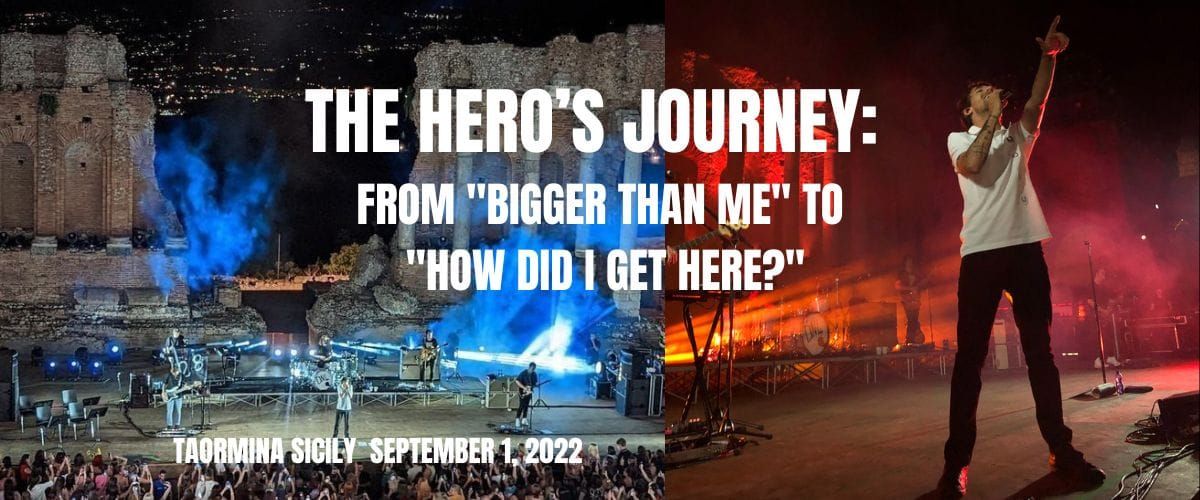
Louis Tomlinson's song "Bigger Than Me" was officially released on September 1, 2022. That was also the date of my first Louis concert at the Ancient Theatre in Taormina, Sicily. It was one of those moments that is hard to put into words. Being at that venue and seeing him felt like something I was supposed to do. Something outside of myself. I can't explain that. But the odds of me being there required many things to fall into place. And they all did.
I never expected that song to be back on his set list for this tour. It was never a fan favorite and it's hard to sing. So, I asked myself why.
"Bigger Than Me" in 2022 was a turning point — not just musically but philosophically. Tomlinson said of that song: "I've always strived to be a very normal, humble person in this life, but there's a line to that and a responsibility that comes from being in this position. I realized from doing those live shows what it means to my fans and how everything I do is bigger than me. It's almost a coming of age for myself, putting opinions about myself to the back of my mind and thinking about what it potentially means for other people."
Who says stuff like that? An authentic voice.
When I say authentic, I mean someone who has been doing this kind of thing, connecting with his audience one-on-one, from the beginning.
That's not just a pop lyric; that's a man articulating a shift in consciousness about the relationship between self and audience, between personal identity and public purpose.
How Did I Get Here? (released January 23, 2026) follows that thread but lands somewhere notably different. Tomlinson described the album as "the record he always deserved to make,” a reference to coming to terms with his journey as a solo artist and his career as a whole. A few of us initially took offense at that because we thought Faith in the Future was a brilliant album. And it is. But it was him looking back. It was him singing for the fans instead of for himself. It was him upholding a narrative that had already changed.
That word— deserved — carries weight. It implies a long negotiation with self-worth, which brings us to a few of the songs.
How Did I Get Here? to How Did We Get Here? That single pronoun swap — I to We — was not a marketing decision. The record is a private reckoning; the tour is the invitation. He cannot stage the album without converting it into a collective. Because it's something he felt and needed to say. And because of this authentic voice, expressing himself from his heart, I believe is why this tour has been successful without the radio play (as usual) because he's more than that now.
“Bigger Than Me” was the beginning of him recognizing that and its continuation this tour is the acceptance of that truth.
The lyrical turn. Faith in the Future was confessional in the older singer-songwriter sense — it metabolized a specific, brutal stretch of his life (specifically the afterlife of One Direction) into songs that pointed inward and backward. How Did I Get Here? is described as sunny, thematically lighter. But the title is the tell. It comes from the closing track "Lucid," and when Apple Music's Zane Lowe asked him about it, he said "It's a statement. I'm not interested in answering the question." That refusal is the philosophical core. A wounded artist excavates the past to understand how they got here. It's a deeply personal journey he didn't want to share.
The philosophical turn, and "Bigger Than Me" as the keystone. His quote about “what it potentially means for other people" — was him articulating a philosophy in 2022 that he hadn't yet fully built an album around. Faith in the Future still pointed the camera at himself. "Bigger Than Me" was the one track where he rehearsed the other-directed stance, which is exactly why it sat oddly in that record and didn't become a fan favorite: it was philosophically ahead of the album it lived on.
So, when he sings it nearly every night — he's not reviving an underdog track for sentiment. He's retroactively reframing it as the origin point. It's the song where the 'we' first appeared. He's telling fans, in effect: this is where the road we're now on actually started.
A behavioral psychologist might call this post-traumatic growth — but the version of it Tomlinson is enacting is unusually specific. The textbook arc is suffering >> meaning >> making >> renewed sense of purpose. The generative, outward turn (caring about what your existence means for others) is a recognized late stage of that arc, and it's exactly the register of the "Bigger Than Me" quote. The interesting wrinkle is that he's not performing a "healed" self. The presence of "Imposter" on the record otherwise about confidence means he's carrying the doubt forward rather than claiming to have resolved it — which is psychologically more credible, and more durable, than a clean redemption narrative.
I am reading the uplifting, communal turn in two ways. First, Louis has claimed his role to lead a wounded fanbase (and the Directioner ecosystem carries an enormous amount of collective trauma and grief, especially post-Payne) toward something lighter, and more authentic and who uses the concert as the vehicle because communion is the point. Second is that Faith in the Future's past-focused heavy-ness is a hard well to keep drawing from, and "sunny" is a commercially and emotionally sustainable place for a 34-year-old to land. Pointing the camera outward is also what saves him from being trapped re-performing his “hard” years forever.
He's ready to move on. He demonstrates this even in his recent Flaunt Magazine “film” article. He's ready to burn old stories down once and for all so that he can move on, and he's asking fans to move on with him. Louis is someone who has done the self-work, examined his shadow and needs his devoted fans to understand the depth of that and how hard it was. So many of his fans have said, “he saved me” and he took that seriously.
Lucid" against "Bigger Than Me": the refusal and the gift
These two songs are the bookends of the whole transformation, and they're doing opposite things with the same problem — the strangeness of his own life.
"Bigger Than Me" (2022) is about resolving the strangeness through duty. Its lyrical content is embracing change and letting go of self-doubt, and the philosophy he attached to it was outward facing from the start. It's the sound of someone deciding to grow up by deciding to be of use, truly a man who has grown emotionally.
"Lucid" (2026) is what happens after the strain dissolves. Lyrically it's nothing like an anthem — it's dreamy, almost dissociative, built out of deliberately mundane, slightly unreal images: linoleum and PVC, walking into a superstore, the floor seeming to ripple underfoot, a sense that everyone around him looks like him. It's the texture of derealization — the genuinely uncanny experience of a life that doesn't feel like it can be real — and over the top of that he repeats the title question and answers it not with an explanation but with a posture: that he'll be okay, that he'll "dream awake." That phrase is the whole philosophy compressed. A lucid dream is one where you know you're dreaming and can act inside it without needing it to make sense or to end. He's not trying to wake up from the strangeness anymore, and he's not trying to solve it. He's chosen lucidity — acceptance and gratitude within the unreal — instead of an answer.
So, the arc from one song to the other is: "Bigger Than Me" answers the strangeness with duty (effortful, outward, a decision); Lucid dissolves it into gratitude (relaxed, present, a state). And when Zane Lowe asked him about the title, he described the question itself mutating in real time: he stops asking "how the fuck did I get here" and slides into "how did we get here? Me and my fans” and then names the feeling plainly: "It's basically gratitude." That is the I-becomes-we conversion happening inside one sentence of an interview, and it's the same conversion the discography makes across four years. "Bigger Than Me" reached for the we as an obligation; "Lucid" arrives at it as a relief. He no longer must carry the fans as a responsibility because they've become the thing that makes the unanswerable question bearable. The gift and the duty have swapped places.
The Question Mark is the literal organizing principle of the entire era, and he's signposted it in the pronoun of the tour, the shape of the stage, the order of the songs, and the title itself. The only thing he won't do is state the answer in prose — because, as he keeps insisting, the refusal to answer is the answer. Would it be different in another life? For him or for any of us?
"Sanity" takes it all a step further by claiming his own headspace, self-reliance, talking to himself, a defiant repetition of I've got my sanity set against long held stories that, at one time, saved him but now haunt him. He has given up the external battle ‘letting it slide’ and rising to a higher emotional vantage.
The ethereal staging - The light-pyramids and the haloed, standing-under-the-beam imagery fits the era's philosophy beautifully. He moved from grounded, gritty aesthetic of Faith in the Future (early-2000s alt-rock, dirt under the nails) to something elevated and transcendent. Bathing him in ethereal light, raising him into beams, is the visual translation of "higher emotional plane." He spent two albums down in the wreckage; this one literally lights him from above. That's the staging telling the same story as the pronoun, the question-mark set, and the song order.
"Dark to Light" carries more than itself. Asked directly on the Zach Sang Show, he declined to over-explain and offered only that it's a story about a friend who felt underappreciated, reminded of how loved they were. Elsewhere he said writing at all after the death felt unimportant, and that Liam appears across the record both directly and in ways that are more subconscious, adding that it won't be too hard for people to join the dots. By his own account, grief isn't quarantined in one song. It's dissolved into the whole album's groundwater. "Dark to Light" is just the one place it surfaces.
Every reviewer reaching for a one-line summary of the record lands on some version of "Dark to Light” the move from the gritty, interior wreckage of Faith in the Future to the elevated, ethereal, light place of How Did I Get Here? One outlet said the track's title is meant to encapsulate the whole album. This tells you the lightness of this album is not naive sunshine. It is grief-derived. The uplift is a response to death — a deliberate turn toward light made by someone who has just watched what happens when someone doesn't make it back. The pastoral impulse from "Bigger Than Me” everything I do is bigger than me, it's for them, reaches its most serious form here. He's not just entertaining a grieving audience; he's modeling the passage through it.
And the chorus's ache — wishing the person could see themselves through his eyes one more time, wondering whether anything he did or could do would have made a difference — carries the unmistakable grammar of survivor's guilt, the is there anything I can do that arrives too late to be answered. The bridge converts that helplessness into a vow: don't go where I can't follow, I'll be by your side — which is the same protective, caretaking reflex that he's now redirected onto Liam's son and onto the fans. The wish he couldn't fulfill becomes the promise he can keep.
Faith in the Future was the wreckage album, a breakup from his past— interior, backward-facing, processing loss and instability, grounded in dirt-under-the-nails alt-rock. Where “Saturdays” ends Faith in the Future with ‘some things change’ and continues into the new tour as a reminder "Bigger Than Me" continues the transcendent journey forward.
How Did I Get Here? is the album that chooses light out of that dark rather than in ignorance of it.
"From the very start of his solo turn, the introspection was already encoded — most cryptically in "369." He never explained it; he dropped the number in reply to a fan in 2021 and let it hang. Most of us at some point landed on the Tesla's triad — 3 for intellect, 6 for emotion, 9 for spirituality — and read it as a map for moving through change with the mind and spirit intact, and whether or not that was the intent, it now reads like a thesis waiting for an album.
Faith in the Future gave us the 3 and the 6: the reflective streak that always set him a little apart from the spectacle of the band, and the raw feeling of a man processing his life in real time. How Did I Get Here? is the 9 — the place where intellect and emotion finally resolve into something steadier, an inner stillness that works, more than anything, as armor.
Against an industry that has spent fifteen years writing his story for him, and against a world that took Liam — a brother he loved — far too soon, he has built a kind of spirituality that can't be bought, sold, or argued out of him. The man who once said he'd pushed his own opinion of himself to the back of his mind to think about what he means to other people has finally found the inner ground to actually do it — not as self-erasure, but from strength.
In How Did I Get Here? he is no longer wallowing in the past, he's looking inward to survive it and then turning that survival into something he can hand across the barricade to the people in front of him.