From Dark to Light: The Quiet Transcendence of Louis Tomlinson
Louis Tomlinson is no longer looking backward to survive the past. He has turned his survival into something whole, handing it across the barricade to his fans as a safe space for all of us to heal.
On September 1, 2022, Louis Tomlinson released "Bigger Than Me." That night, I found myself sitting in the ancient amphitheater in Taormina, Sicily, watching him take the stage. Standing among thousands of fans carved into an ancient hillside, the alignment felt almost impossibly deliberate. The odds required to get me to that place at that time had felt insurmountable, but every piece fell into place. It was a moment beyond ordinary explanation—a rare alignment where time, place, and music intersected to reveal something much larger than the sum of its parts.
In an era dominated by hyper-calculated PR strategies, "authenticity" has become industry shorthand - a buzzword PR teams drape around an artist like a carefully chosen outfit, hoping it passes for a personality. But true authenticity isn’t an aesthetic you wear, a scripted line you deliver on stage, or copying someone else. It is lived, breathed, and proven when the lights go up. Louis has been living and breathing authenticity from the start.
While others rely on manufactured humility to construct a brand, Louis Tomlinson’s groundings require no spin. Reflecting on his music and live tour around "Bigger Than Me," Louis captured a rare, unvarnished self-awareness:
"I've always strived to be a very normal, humble person in this life, but there's a line to that and a responsibility that comes from being in this position. I realized from doing those live shows what it means to my fans and how everything I do is bigger than me."
That statement reveals the core of what being genuine actually means. It isn’t a performance of down-to-earthness for corporate approval; it is the conscious decision to set ego aside and honor the unfiltered connection shared with an audience. "Bigger Than Me" was never just a pop song—it was a philosophical shift in consciousness regarding the sacred relationship between self and audience, personal identity and public purpose.
Looking back, "Bigger Than Me" sat as a keystone track ahead of its time. On 2022’s Faith in the Future, Louis still had the camera pointed largely at himself. That album was a confessional, grit-under-the-fingernails processing ground—an intimate, visceral wrestle with the afterlife of One Direction, personal trauma, and profound grief. It metabolized a brutal stretch of life into songs that pointed inward and backward, trying to carry the weight of what had been broken.
"Bigger Than Me" was the single track on that record where he rehearsed an other-directed stance. It was philosophically ahead of the album it lived on.
Then came How Did I Get Here?
When the album was announced, Louis described it as "the record he always deserved to make." At first, some of us balked—Faith in the Future was a brilliant record, after all. But Faith in the Future was Louis singing for his fans to protect a narrative that had already run its course. The word deserved carries a heavy, quiet weight; it implies a long, exhausting negotiation with self-worth.
If Faith in the Future was about surviving the wreckage, How Did I Get Here? marks a radical shift into full acceptance. It isn't an album that chooses light out of ignorance, but one that chooses light out of the dark.
The album’s title comes from the closing track, "Lucid." When Zane Lowe pressed him on the question, Louis offered a brilliant boundary: "It's a statement. I'm not interested in answering the question." Early in his career, he tried to solve the impossible puzzle of how he got here.
After fifteen years in an industry that sought to write his story for him, he realized there is no neat answer—that his reality is simply out of the ordinary, and he no longer owes anyone an explanation.
That shift translates directly to the live stage. The subtle swap from How Did I Get Here? as a private album title to How Did We Get Here? for the tour isn't a marketing gimmick. The record is a private reckoning; the tour is the invitation. He cannot stage the album without converting it into a collective experience.
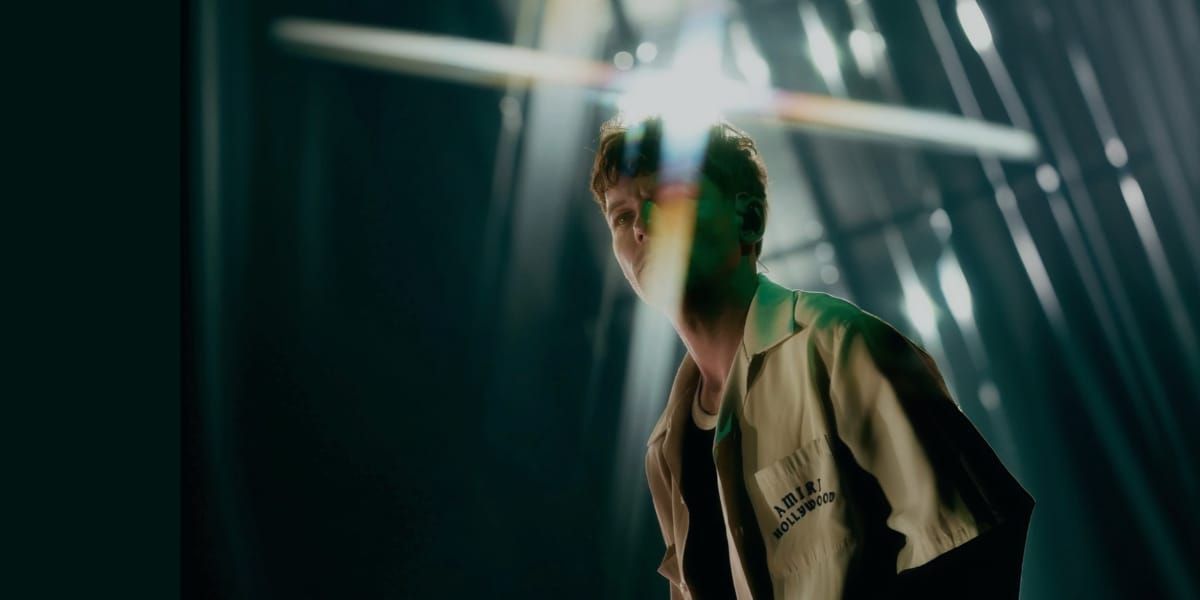
Visually, the transformation is undeniable. Where Faith in the Future was rooted in early-2000s alt-rock dirt and interior processing, this era ascends into the ethereal. Beneath light-pyramids and haloed beams, he is literally bathed in light from above. Raising him into these luminous structures is the visual translation of a man stepping onto a higher emotional plane.
He spent two albums down in the wreckage; now, the staging reflects a transcendent inner stillness.
This emotional evolution feels like the completion of a long-term architecture. From the earliest days of his solo career an intriguing introspection was encoded into his identity. Perhaps most cryptically through his casual mention of "369" years ago. Some fans made it an inside sex joke. Maybe it was a random typo he decided to roll with. Perhaps he was referencing the 963 hertz Solfeggio frequency used in sound therapy to stimulate higher spiritual consciousness. I tend to think he was referencing the triad in modern numerology: 3 for intellect, 6 for emotion, and 9 for spirituality—a map for moving through massive personal transformation with the mind and soul intact. Just my theory. If so:
- Faith in the Future delivered the 3 and the 6: the reflective intellect that set him apart, paired with the raw, bleeding emotion of a man processing his life in real time.
- How Did I Get Here? is the 9—the place where intellect and emotion finally resolve into quiet enlightenment.
He is ready to burn down the old stories once and for all. This era isn't about feeding tired conspiracy theories or remaining anchored to past trauma. Louis has done the grueling, quiet shadow-work. He took it to heart every single time a fan said, "you saved me," carrying that responsibility with immense reverence.
He is no longer asking us to stay in the dark with him. He is inviting us to match his evolution: to drop the weight of past chapters, step into the light, and allow the music to transform us the same way it has transformed him.
Against an industry that constantly tried to define him, and against a world that took Liam—a brother he loved—far too soon, Louis has built a quiet spirituality that cannot be bought, sold, or spun. The man who once pushed his opinion of himself into the background to consider what he meant to others has finally found the ground beneath his feet. Not out of self-erasure, but out of absolute strength.
He is no longer looking backward to survive the past. He has turned his survival into something whole, handing it across the barricade to his fans as a safe space for all of us to heal.