The Sitting Room
At sundown he walked back to camp with a phone full of toilet photos and a sunburn in the shape of a door frame. Campmates asked what he'd done all day. He said he'd been to a gallery and pointed down the road at the long line of plastic boxes, glowing pink in the last of the light.
The story behind the book
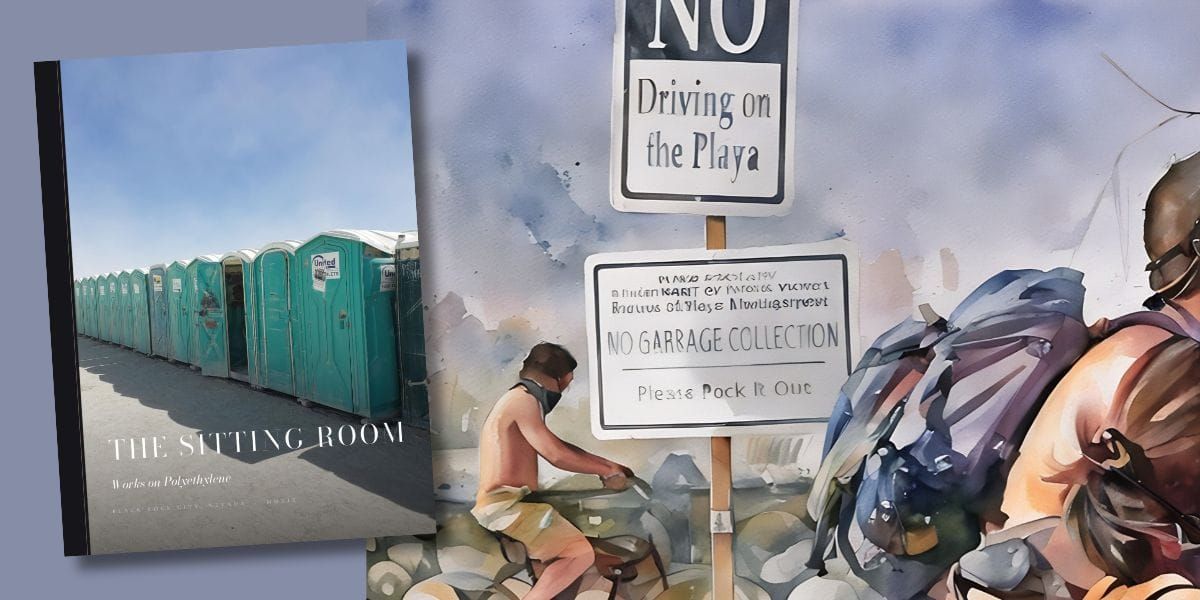
Every portable toilet is a gallery, and nobody is minding any of them. Over a single afternoon in Black Rock City, Nevada, in 2019, these unattended works were photographed, titled and catalogued with the seriousness they did not ask for.
Every Burning Man has its rituals. Some people build a forty-foot temple and set it on fire. Some people ride a bicycle disguised as a jellyfish. On the afternoon of September 1st, 2019, a man named Steve walked into a porta-potty and did not come out for what witnesses described as "a concerning amount of time."
He wasn't unwell. He was reading.
"It started with one," he says, in the voice of a man who had to explain this to a gathering crowd of geeked up festival goers. "The door said FOLLOW YOUR MELON HEART. I didn't know what that meant. I still don't. But I knew it meant something to somebody."
He took a photo. Then he looked to his left, where someone had written YOU ARE ENOUGH, with a small heart tucked under the line like a footnote. He took a picture of that, too. Then he looked up, which turns out to be the one thing nobody does in a porta-potty, and that's where the real collection was.
By the time he came out, there was a line. A man wearing a fur vest and nothing else asked if he was okay. Steve said, "Have you been in number fourteen? There's a Descartes quote." The man in the fur vest did not go into number fourteen.
What followed was, by any reasonable standard, an unreasonable afternoon. Steve worked his way down the row like a museum guard who had lost his museum. Open door. Step in. Photograph. Step out. Apologize. Next. He developed a technique. He developed a stance. By the third bank of units, he could hold his breath for ninety seconds, a skill that has served him well at family reunions.
He noticed things. The teal units were chatty, all encouragement and anatomy. The blue ones were moodier: a lot of name badges, one ad for a private detective. The grey ones read like a government office that had given up hope. ALL PAPERWORK MUST BE SIGNED IN TRIPLICATE. He started sorting them in his head by color, the way an art historian would, if the art historian were standing in the desert in goggles, explaining himself to a volunteer named Moonbeam.
"Sir, you've been in and out of that one six times."
"The light changed."
"The light?"
"It's lit from above. There's a panel. You get maybe twenty minutes of good light before it goes flat."
Moonbeam wrote something on a clipboard. Steve believes to this day he was being nominated for something.
There is a particular loneliness in being the only person who can see that a thing is beautiful.
Seventy thousand people passed these walls that week. They read them the way you read a cereal box, then walked back out into the dust and forgot. Steve could not forget. Someone had written CALL MUM in capital letters, in a box in the desert, to a stranger they would never meet.
At sundown he walked back to camp with a phone full of toilet photos and a sunburn in the shape of a door frame. His campmates asked what he'd done all day. He said he'd been to a gallery. They asked which one. He pointed down the road at the long line of plastic boxes, glowing pink in the last of the light, and said, "All of them."
Two weeks later, the trucks came. The pressure washers did what pressure washers do. Every word, every cat, every cryptic penis drawing, every heart under every baseline went into the great municipal nowhere. The exhibition closed without a press release.
Except for one phone.
Years later, the phone became a book. Hardbound, full color, four movements, with a foreword that takes itself exactly as seriously as it should. People pick it up because it looks expensive. They keep turning pages because they can't believe what they're looking at. Then, somewhere around the Blue Period, they start to recognize themselves in the unforgettable moments when simple things bring a knowing smile.
Steve still looks up. He would like you to know that the light in a porta-potty is genuinely very good, that nobody ever believes him about this, and that the line outside is not his fault.
Mostly not his fault.
Want something else to talk about during the holidays instead of the turkey or grandpa's surgery?
The Sitting Room is Out Now
The Sitting Room: Works on Polyethylene is available on Amazon.